Brushless DC (BLDC) Fans are widely used in modern homes because of their high efficiency, low maintenance, and long lifespan. However, even the most reliable systems can face issues over time. Understanding the common BLDC fan problems and knowing how to fix them is essential for every individual.
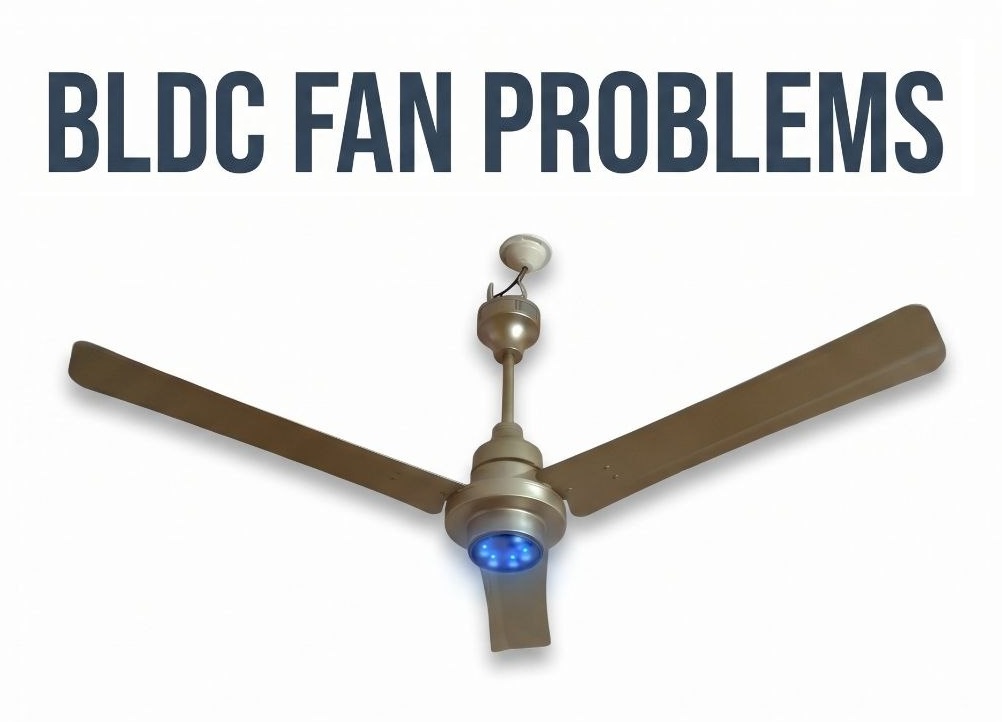
BLDC Fans Problems:
The common problems with BLDC Fans are
- Slow running
- Noise and Vibration Issues
- Speed Fluctuations and Instability
1. Slow Running Problem:
A fan capacitor provides the appropriate power to the fan. Ninety percent of speed issues in fans are caused by poor capacitor performance. In case of capacitor failure, power is not appropriately transferred to the fan’s motor. Hence, this can be the reason why your fans are running slowly.
How does capacitor failure affect fan speed?
A capacitor is an electrical component that stores energy in the form of an electric field. In the context of fan motors, capacitors are often used to provide a boost of energy to help the motor start spinning or to improve its efficiency.
Starting Torque: When a fan motor is first turned on, it requires a surge of energy to overcome the initial resistance and start spinning. A capacitor can provide this initial boost of energy, helping the motor to start more efficiently.
Efficiency and Power Factor: Capacitors can improve the power factor of a fan motor, which is the ratio of the real power (Watts) to the apparent power (Volts-Amps). By improving the power factor, capacitors can reduce energy losses and increase the overall efficiency of the motor.
Voltage Regulation: Capacitors can also help to regulate voltage fluctuations, which can be particularly important in situations where the power supply is unstable or unreliable.
Solution:
Replace the faulty capacitors with new ones with the same rating.
2. Noise and Vibration Issues:
With time, the fan’s ball bearings may wear out or accumulate dust, debris, and dirt particles. Because of such factors, you can face the issue of fans running slowly, as it makes it difficult for the bearings to move.
Solution:
It is due to a lack of lubrication; apply some lubricant to the bearing to sort out this issue, otherwise the bearing needs to be changed if it is worn out.
3. Speed Fluctuation and Instability:
Voltage fluctuations in the power supply can cause speed instability. Another main cause of speed fluctuation is poor feedback control. In closed-loop systems, incorrect PID tuning can lead to oscillations or slow response times.
Hall sensors play a critical role in many BLDC motor systems by providing rotor position feedback. When these sensors fail, the motor may run erratically or stop completely.
Common causes of Hall sensor failure include wiring issues, overheating, and physical damage. In some cases, electromagnetic interference can disrupt sensor signals.
Solution:
Replace the faulty Hall sensor with a new one to restore the speed.
Note: In sensorless fans, back-EMF sensing can be problematic due to failure of the microprocessor in the control circuit.