
A Complete Guide to EV Fast Charging and DC Electric Vehicle Charging:
As electric vehicles become more popular, the demand for reliable EV fast charging stations continues to grow. Whether you’re planning a long road trip or simply looking for a quicker way to recharge your vehicle, understanding DC fast charging and modern Electric vehicle charging solutions is essential. This guide explains how EV fast charging stations work, their benefits, and what drivers should know before using them.
What Are EV Fast Charging Stations?
EV fast charging stations are public or private charging points designed to recharge electric vehicle batteries much faster than standard AC chargers. Most fast chargers use direct current (DC) to deliver high power directly to the battery, significantly reducing charging time.
Power Flow: Grid → Transformer → Switchgear → Rectifier → DC Charger → EV
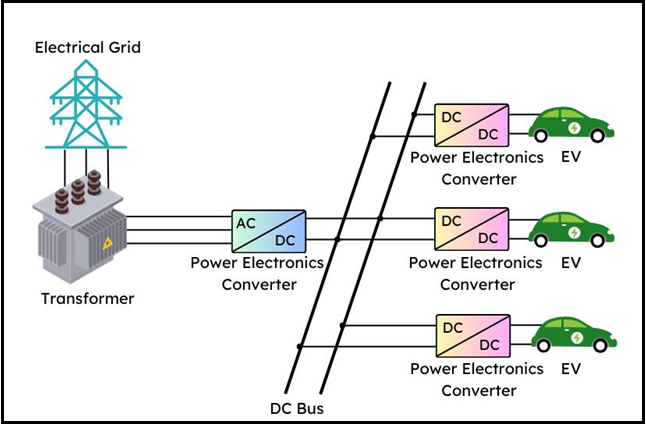
Unlike conventional home chargers, these stations are commonly installed along highways, commercial centers, workplaces, and urban charging hubs to support long-distance travel and reduce charging delays.
How Does DC Fast Charging Work?
DC fast charging bypasses the vehicle’s onboard AC charger and supplies direct current straight to the battery. This allows much higher charging speeds, with many stations delivering between 50 kW and 350 kW of power, depending on the charger and the vehicle’s capabilities.
Charging speed depends on several factors, including:
- Battery size
- State of charge
- Battery temperature
- Maximum charging rate supported by the vehicle
- Power output of the charging station
Most electric vehicles charge fastest when the battery is between 20% and 80%, after which charging speeds gradually decrease to protect battery health.
Benefits of EV Fast Charging Stations
Fast charging offers several advantages for electric vehicle owners:
- Significantly reduces charging time compared to standard AC charging.
- Makes long-distance travel more convenient.
- Expands confidence in electric vehicle ownership.
- Supports commercial fleets and ride-sharing services.
- Increases accessibility to public Electric vehicle charging infrastructure.
These benefits are helping accelerate the transition to cleaner transportation worldwide.
Types of Electric Vehicle Charging
Electric vehicle charging is generally divided into three categories: Level 1, Level 2, and Level 3 (also known as DC Fast Charging). Each level offers different charging speeds, with Level 1 being the slowest and Level 3 being the fastest.
Level 1 Charging
- Uses a standard household outlet.
- Best suited for overnight charging.
- Slowest charging option.
Level 2 Charging
- Uses a dedicated 240V AC charger.
- Common in homes, offices, and public parking areas.
- Provides a good balance of speed and convenience.
Level 3 DC Fast Charging
- Uses high-powered direct current.
- Primarily available at public EV fast charging stations.
- Ideal for highway travel and quick top-ups.
Where to Find EV Fast Charging Stations
Fast charging infrastructure is expanding rapidly across cities and highways. Drivers can commonly find EV fast charging stations at:
- Highway service areas
- Shopping malls
- Retail parking lots
- Hotels
- Business districts
- Fleet depots
- Public charging hubs
Many navigation apps and vehicle infotainment systems also display nearby charging stations, charger availability, and estimated charging times.
Tips for Using DC Fast Charging Efficiently
To get the best experience from DC fast charging:
- Charge before the battery becomes empty to zero.
- Disconnect once the battery reaches around 80% if continuing a long journey.
- Check connector compatibility before arriving.
- Avoid repeated fast charging sessions in extreme temperatures whenever possible.
- Plan charging stops in advance during long trips.
These practices help improve charging efficiency while supporting long-term battery performance.
The Future of Electric Vehicle Charging
The future of Electric vehicle charging focuses on delivering faster, smarter, and more accessible solutions. New technologies are increasing charging power, reducing wait times, and integrating renewable energy with charging networks. Features such as intelligent load management, battery preconditioning, and ultra-fast charging are expected to become more common as electric vehicle adoption continues to grow.
EV fast charging stations are transforming the way drivers power their electric vehicles by making charging faster, more convenient, and increasingly accessible. As DC fast charging technology continues to improve and Electric vehicle charging infrastructure expands, electric mobility will become even more practical for everyday commuting and long-distance travel. Understanding how these charging systems work enables drivers to make informed decisions and enjoy a smoother electric driving experience.


